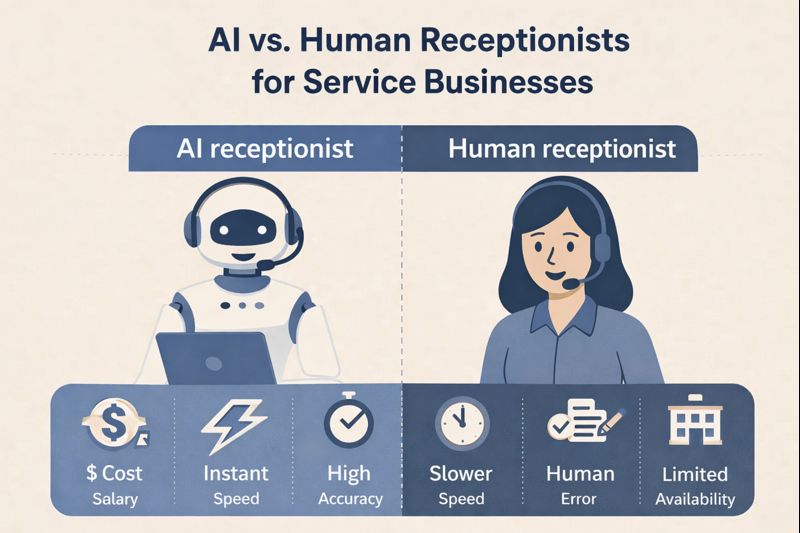
AI vs. Human Receptionists: Cost, Accuracy, and Speed Comparison
AI receptionists offer significant cost advantages, operating at a fraction of the cost of human staff without salaries or benefits. They provide 24/7 availability, reduce response times to under 30 seconds, and can increase lead-to-appointment conversion rates by up to 70%. While human receptionists remain valuable for complex or emotional situations, AI excels at consistent, automated tasks such as call handling, scheduling, and data entry.
For service-based businesses, reception tasks play a critical role in lead capture and customer experience, but they are often time-consuming and expensive to manage. Traditionally, these responsibilities fall to human staff. Today, the rise of the AI receptionist a virtual assistant powered by advanced voice AI—offers a scalable and cost-effective alternative.
While human receptionists bring empathy and judgment, AI receptionists outperform in areas such as speed, consistency, and availability. Understanding how these two approaches compare helps business owners decide which solution best supports their operations.
Cost and Scalability: The Economic Difference
One of the most noticeable differences between AI and human receptionists is cost, especially for small and growing service businesses.
“AI vs human receptionist” is rarely a single yes/no decision; most businesses choose based on call volume, intake complexity, scheduling rules, and how often calls come in after hours. If you want a broader comparison that includes answering services—not just in-house reception—start with this educational hub on AI receptionist vs answering services. It provides a category-by-category lens (law, home services, medical, professional services) so you can evaluate the tradeoffs in context.
Human Receptionist Costs
Hiring a full-time receptionist involves ongoing expenses beyond salary, including benefits, training, workspace, sick leave, and vacation time. These fixed costs can place a significant financial strain on smaller businesses and limit flexibility during slower periods.
AI Receptionist Cost Savings
AI receptionist solutions are far more affordable. Many operate for as little as $0.69 per hour or under $10 per day. There are no benefits, overtime, or paid time off to manage. In many cases, businesses recover the cost of an AI receptionist by booking just one additional appointment. Overall, AI receptionists can reduce operational costs by as much as 60%.
Scalability During Busy Periods
Human staff can only handle one interaction at a time and may become overwhelmed during peak seasons or promotions. AI receptionists scale instantly, handling multiple calls or messages simultaneously without service degradation. This allows businesses to maintain consistent customer service without hiring additional staff.
Speed and Availability: The 24/7 Advantage
Speed and availability are critical factors in converting leads, particularly for service businesses where customers expect immediate responses.
Limitations of Human Availability
Human receptionists are constrained by business hours, breaks, and holidays. Missed after-hours calls often result in lost opportunities, as potential customers may contact competitors instead. Long hold times during busy periods can also frustrate callers.
AI Receptionist Speed and Coverage
AI receptionists operate 24/7, ensuring the business is always accessible. Calls are answered immediately, even outside standard business hours. Businesses that adopt AI receptionists often see response times drop to under 30 seconds, dramatically improving first impressions and lead capture.
Accuracy and Consistency in Customer Interactions
Consistency and accuracy are essential for maintaining a professional customer experience.
Human Error and Inconsistency
While human receptionists can provide empathy, mistakes in scheduling, data entry, or message handling can occur, especially during busy periods or long shifts.
AI Accuracy and Conversion Performance
AI receptionists deliver consistent, accurate responses across all interactions. By automating scheduling, lead capture, and data entry, they significantly reduce the risk of errors. This reliability directly impacts business performance, with many companies reporting 49–70% increases in lead-to-appointment conversion rates and customer satisfaction improvements of up to 40%.
Handling Complex Situations and Limitations
Despite their strengths, AI receptionists are not suited for every scenario.
Emotional or complex conversations: AI may struggle with highly emotional discussions or unusual requests.
Human escalation: When needed, AI receptionists can detect complexity and use smart call routing to transfer the interaction to a human team member.
In practice, AI receptionists are most effective when used alongside human staff. They handle repetitive, routine, and after-hours tasks, allowing human employees to focus on complex, sensitive, or high-value interactions.
FAQs
What is the main difference between an AI receptionist and a human receptionist?
An AI receptionist is software that answers calls 24/7, responds in seconds, and can handle many callers at once using a consistent script. A human receptionist brings real empathy and judgment, but is limited by shifts, breaks, and peak-hour capacity. Most businesses use AI for speed and coverage, with humans for exceptions.
How much cheaper is an AI receptionist compared to a human receptionist?
AI receptionist plans often start near $0.69 per hour (about $10 a day) plus small usage charges, with no benefits, onboarding, or overtime. A full-time U.S. receptionist commonly costs $3,000–$5,000+ per month after payroll taxes and coverage gaps. For many service businesses, one extra booked job can offset the monthly AI spend.
Are AI receptionists faster than human receptionists?
In most setups, yes. An AI receptionist can pick up immediately and begin qualifying the caller within seconds, even during lunch, evenings, and busy rushes. A human receptionist may miss calls, send callers to voicemail, or place them on hold when multiple lines ring. Faster answering usually raises lead-to-appointment conversion for urgent services.
Can AI receptionists really handle multiple calls at the same time?
Yes. AI receptionists are built to run concurrent conversations, so they can answer multiple calls (and texts or chats) at the same time without a busy signal. During peak periods—like storms for roofers or heat waves for HVAC—this prevents long hold times. Each caller still receives the same scripted questions, booking options, and follow-up messages.
Are AI receptionists accurate when scheduling appointments?
They can be very accurate when integrated with your calendar or booking system. The AI checks real-time availability, applies your rules (service area, appointment length, buffers), and writes the booking automatically, which reduces typos and missed details. It also prevents double-booking by reading live calendar data. Accuracy depends on correct setup and clear scheduling rules.
Do AI receptionists improve lead conversion rates?
Often, yes. The biggest conversion lift comes from instant answering and removing the voicemail step. When callers get help right away, they’re less likely to call the next provider. Many service businesses report lead-to-appointment gains in the 49–70% range after adding AI answering, qualification questions, and real-time scheduling, especially after hours and during high-volume periods.
When is a human receptionist still better than AI?
A human receptionist is still best when the call requires empathy, negotiation, or nuanced judgment—such as upset clients, sensitive medical situations, or complex billing disputes. Humans also handle unusual edge cases that don’t fit a defined script. A practical approach is hybrid: AI answers first, collects details, and routes urgent or sensitive calls to a person immediately.
Can AI receptionists replace human receptionists completely?
For some businesses, it can cover most front-desk work, but “complete replacement” depends on your call types. AI excels at answering, screening, booking, and updating records consistently. If your team needs deep problem-solving, sales negotiation, or emotional support, you’ll still want humans for those situations. Many companies replace after-hours coverage first, then expand AI to overflow and routine calls.
Is using an AI receptionist suitable for service businesses?
Yes—especially for appointment-driven and urgent-response industries. HVAC, plumbing, roofing, electricians, dental, legal, and medical offices benefit because speed and availability directly affect bookings. AI can answer 24/7, capture job details, qualify the caller, and book the next step immediately. It’s also useful for multi-location businesses because one system can standardize how every call is handled.
Does using an AI receptionist affect customer trust?
Usually it improves trust when it sounds natural and follows clear rules. Callers care most about getting help quickly, not whether the agent is human. A well-configured AI provides a professional greeting, accurate answers, and fast scheduling, then escalates to a person when needed. Trust drops when AI makes promises it can’t keep, so guardrails and safe routing matter.
AI receptionists are not designed to replace humans entirely. Instead, they complement human staff by providing constant availability, faster response times, and consistent execution of routine tasks. For service businesses focused on efficiency, lead capture, and scalability, AI receptionists offer clear operational advantages while preserving the option for human involvement when it matters most.
In some industries, such as legal services, reception and intake play a critical role in deciding whether a case is accepted or declined. We explore how AI receptionists support legal intake and missed-call recovery in our article on AI receptionist for law firms.
If you’re deciding between hiring a receptionist (or paying an answering service) vs. using AI, the real question is simple: how many calls are you missing right now? When a lead hits voicemail or waits on hold, they usually call the next business—especially in HVAC, plumbing, roofing, and legal intake. Our AI Receptionist answers instantly, works 24/7, qualifies callers, and books appointments into your calendar so you capture more jobs without adding payroll. See the full system or call (888) 898-3151 to get a quick demo.
